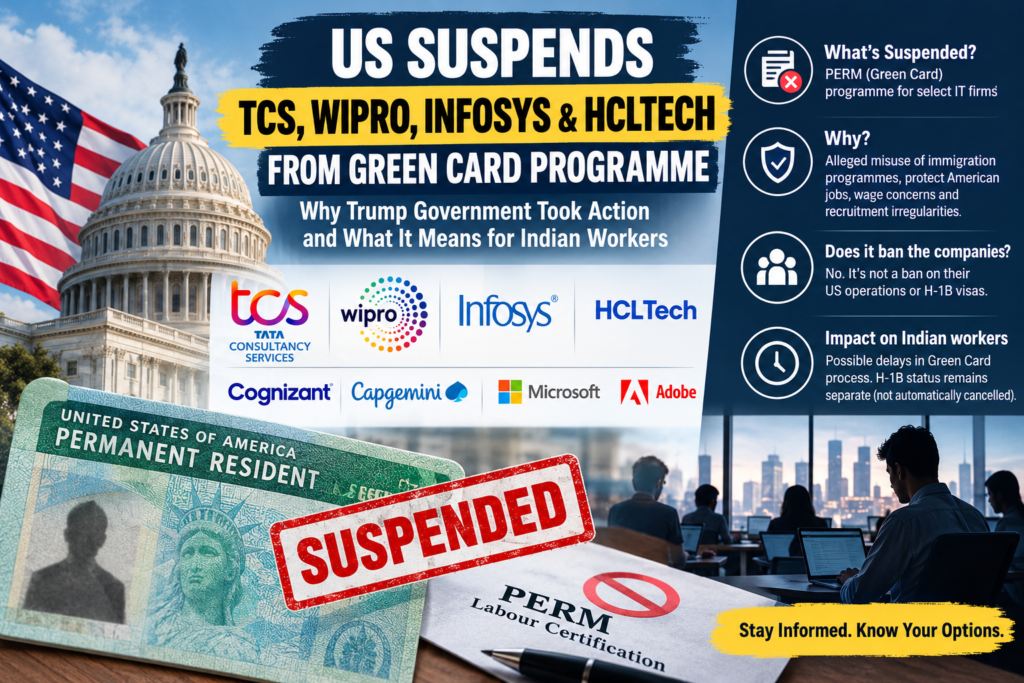
A major immigration development in the United States has put some of the world’s largest technology companies under fresh scrutiny. On October 8, 2026, the US government announced the suspension of several major IT companies from the employment-based Green Card process known as PERM.
The affected companies named in the announcement include Tata Consultancy Services (TCS), Wipro, Infosys, HCL Technologies (HCLTech), Cognizant and Capgemini. Microsoft and Adobe were also suspended amid federal investigations, according to Reuters and the Associated Press.
The decision has raised important questions for Indian technology professionals working in the United States. Does this mean these companies have been banned from operating in America? Will employees lose their H-1B visas? Can workers still apply for a US Green Card?
The most important distinction is that the announced action concerns the PERM labour certification programme, which is an important step in many employer-sponsored employment-based Green Card cases. It is not, by itself, a blanket ban on these companies’ US businesses or an automatic cancellation of their employees’ existing H-1B status.
This article explains what has been announced, the government’s stated reasons, the difference between PERM and H-1B, and the potential consequences for Indian workers.
Sources: Reuters, October 8, 2026; Associated Press, October 8, 2026; The Indian Express, October 9, 2026.
1. What Exactly Did the US Government Announce?
On October 8, 2026, US Labor Secretary Keith Sonderling announced that several major IT outsourcing companies would be suspended from the Permanent Labor Certification programme.
The companies named in the announcement were:
- Tata Consultancy Services (TCS)
- Wipro
- Infosys
- HCL Technologies (HCLTech)
- Cognizant
- Capgemini
Microsoft and Adobe were also included in the action, with the administration citing multiple active federal investigations.
According to Reuters, the Labor Department said it would not accept new PERM applications involving the affected companies or process their pending applications.
This is significant because PERM is an important part of the process through which US employers sponsor eligible foreign employees for permanent residency.
However, the scope of this announcement must be understood accurately. The action is directed at the PERM process. It does not automatically mean that all employees of these companies have lost their jobs, that their existing work visas have been cancelled, or that the companies can no longer provide services in the United States.
The duration and individual consequences of the suspension will depend on the applicable government action and any subsequent developments.
2. Why Did the US Suspend These Companies?
The Trump administration says the action is intended to prevent alleged immigration-programme abuse, protect American workers and ensure that employers follow the rules governing the recruitment of foreign workers.
The government’s concerns centre on several issues.
A. Alleged displacement of American workers
The administration argues that employers should not use foreign-worker programmes to replace American employees when qualified US workers could fill the positions.
Vice President JD Vance criticised Microsoft’s use of foreign-worker programmes while referring to layoffs of American employees.
The administration presented the relationship between layoffs and foreign-worker hiring as a reason for increased scrutiny.
However, the fact that a company lays off American workers and also employs foreign workers does not, by itself, prove that those foreign workers replaced the people who were laid off. Establishing that would require evidence about the specific jobs, recruitment decisions and circumstances involved.
B. Concerns about recruitment practices
Under the PERM system, employers generally have to complete prescribed recruitment steps before seeking labour certification for a foreign employee.
The purpose is to assess whether hiring a foreign worker permanently would adversely affect the job opportunities, wages or working conditions of similarly employed US workers.
The administration has alleged that some employers use ineffective recruitment advertisements and then claim that qualified American candidates are unavailable.
The government says such practices could undermine the purpose of the labour certification process.
These are the administration’s allegations and stated concerns. They should not be interpreted as proof that every affected company committed fraud in every application.
C. Alleged wage undercutting
Another concern raised by US officials is that employers might use foreign-worker programmes to reduce labour costs.
The administration argues that hiring foreign workers at lower wages could disadvantage American employees.
However, the existence of an H-1B worker does not automatically establish that the worker is being underpaid or that an employer has violated wage rules. Each case depends on the applicable requirements and evidence.
D. Broader enforcement against immigration fraud
The action forms part of a broader effort by the Trump administration to increase scrutiny of employment-based immigration programmes.
The US Department of Labor’s Office of Inspector General announced an investigation into H-1B visa fraud and human trafficking on July 8, 2026.
That investigation focused on alleged fraudulent applications, coercive wage arrangements and schemes involving labour brokers. It is relevant background to the government’s wider enforcement approach, but it does not independently establish wrongdoing by every company named in the October 8 announcement.
3. What Is PERM, and Why Does It Matter for a Green Card?
PERM stands for Permanent Labor Certification. It is an employment-based labour certification process administered by the US Department of Labor.
For many employer-sponsored employment-based Green Card cases, an employer must first complete the required labour certification process before proceeding to the next stage.
In general, the employer must establish that the position meets the applicable requirements and carry out the prescribed recruitment process.
The purpose is to determine whether permanently hiring a foreign worker would adversely affect US workers’ wages, working conditions or employment opportunities.
A simplified version of the process is:
- The employer identifies a qualifying permanent position.
- The employer obtains the required prevailing wage determination.
- The employer carries out the required recruitment steps.
- The employer submits a PERM labour certification application.
- If the labour certification is approved, the employer may proceed to the relevant next stage of the employment-based Green Card process, subject to the applicable rules.
- The employee’s case continues through the required immigration procedures, which may include an immigrant petition and an application for permanent residence when eligible.
The exact process depends on the immigration category and the circumstances of the individual case.
Why is the PERM suspension important?
If an affected employer cannot submit a new PERM application while the suspension remains in effect, an employee whose case has not yet reached that stage may have to wait.
For Indian professionals, the consequences can be particularly important because employment-based Green Card categories for Indian nationals have experienced substantial backlogs.
A delay at the labour certification stage can therefore affect the timing of the wider immigration process.
Official reference: US Department of Labor — Foreign Labor Application Gateway
4. PERM vs H-1B Visa: What Is the Difference?
One of the biggest misunderstandings surrounding this news is the assumption that a PERM suspension means an H-1B visa suspension.
These are different immigration processes.
| Feature | PERM | H-1B visa |
|---|---|---|
| Main purpose | Labour certification for many employer-sponsored Green Card cases | Temporary employment in qualifying specialty occupations |
| Immigration status | Part of a permanent-residency pathway | Temporary non-immigrant work status |
| Main application context | Employer-sponsored labour certification | Employer petition for a foreign worker |
| Does this announcement directly cancel it? | New and pending PERM applications involving affected companies are covered by the announced action | The PERM action does not automatically cancel an employee’s existing H-1B status |
| Main potential consequence | Delay or interruption in starting or continuing the PERM stage | Existing status and future visa matters remain subject to their own rules |
Does this mean TCS employees can no longer work in America?
No such blanket conclusion follows from the PERM announcement.
An employee’s ability to work in the United States depends on their actual immigration status, the validity of their authorisation and compliance with the relevant rules.
A PERM suspension does not automatically revoke every H-1B visa held by employees of the affected companies.
However, employees whose permanent-residency cases depend on a new PERM filing may face delays. In some circumstances, the inability to start the process could also create additional complications for workers approaching H-1B time limits.
The effect on each employee depends on the stage of the case and the immigration rules that apply to them.
5. Which Companies Are Affected?
Tata Consultancy Services (TCS)
TCS was named among the major IT outsourcing companies included in the suspension announcement.
The company is a major provider of technology and consulting services and employs professionals across multiple countries.
The announced action concerns its involvement in the PERM labour certification process, not a general prohibition on providing services in the US.
Reuters reported that TCS declined to comment when approached about the announcement.
Wipro
Wipro was also named in the suspension announcement.
The potential direct impact concerns employer-sponsored Green Card cases requiring PERM processing. The announcement does not establish that every Wipro employee in the United States is affected.
Infosys
Infosys was included among the companies named by the US Labor Department.
The immediate concern is for employees whose Green Card sponsorship depends on PERM applications that cannot be filed or processed during the suspension.
HCLTech
HCL Technologies was named alongside TCS, Wipro, Infosys and other IT outsourcing firms.
The consequences for an individual HCLTech employee will depend on the employee’s immigration category, current status and the stage of the Green Card case.
Cognizant and Capgemini
Cognizant and Capgemini were also named in the announcement.
Their inclusion demonstrates that the action is not limited to Indian-headquartered companies.
Microsoft and Adobe
Microsoft and Adobe were included separately, with the administration citing multiple active federal investigations.
Microsoft publicly disputed the implication that its H-1B filings primarily represented new foreign hires.
According to Reuters, Microsoft said approximately 80% of the H-1B applications it filed in the previous fiscal year were for extensions or changes of status for existing employees, rather than new hires.
The company also said it paid H-1B employees the same as other employees performing comparable work.
Those statements are Microsoft’s response to the government’s criticism; they do not, on their own, resolve the underlying allegations.
6. What Do the Government’s Immigration Numbers Mean?
US Labor Secretary Keith Sonderling said the companies covered by the announcement had, since 2009, sought almost three million foreign workers and received more than 230,000 H-1B visa approvals and more than 100,000 permanent labour certifications.
These figures were cited by the administration as part of its explanation for the action.
They require careful interpretation.
- Almost three million foreign workers sought: This is the figure cited by the administration for the companies’ requests since 2009. It should not automatically be interpreted as three million distinct people who entered the United States or obtained permanent residency.
- More than 230,000 H-1B approvals: This refers to approvals cited by the administration. An approval count should not automatically be treated as the number of unique workers currently employed by the companies.
- More than 100,000 permanent labour certifications: This is the number cited for labour certifications obtained since 2009. A labour certification is not the same thing as a final Green Card approval.
The categories measure different things. They should not be added together or presented as if they represent a single count of foreign workers who took American jobs.
The administration argues that the figures demonstrate the scale of the companies’ use of employment-based immigration programmes. The figures alone, however, do not establish that every application was improper or that every foreign worker displaced an American employee.
7. How Could This Affect Indian IT Professionals?
The most direct potential impact is on workers whose employer-sponsored Green Card cases have not yet completed the PERM stage.
Employees waiting to start the Green Card process
Workers whose employers have not yet submitted their PERM applications may face delays while the suspension remains in place.
This can postpone the beginning of the labour certification stage and potentially affect the timing of later steps.
Employees already waiting for a Green Card
Not every employee is in the same position.
A person whose labour certification and subsequent immigration filings have already progressed may be in a different situation from someone whose employer has not yet submitted PERM paperwork.
The suspension should not be assumed to automatically cancel every previously approved immigration filing. The precise consequences depend on the case stage and the terms of the government’s action.
Employees approaching the H-1B time limit
Some H-1B workers may face additional uncertainty if they need to begin the PERM process to qualify for particular extensions beyond the normal six-year limit.
US immigration law provides certain extension options when specified conditions are met. The inability to begin the labour certification process may therefore be significant for some employees.
It does not mean that every affected employee automatically loses eligibility for an extension.
Indian nationals facing Green Card backlogs
India has a large number of applicants in employment-based Green Card categories relative to the available annual visa numbers.
The Indian Express reported that the September 2026 Visa Bulletin listed the employment-based EB-2 category for India as unavailable for final action, while the EB-3 final-action date was January 1, 2014.
Visa Bulletin dates change over time, so readers should consult the relevant month’s official bulletin before making immigration decisions.
A PERM delay can be particularly consequential for an employee who has not yet entered the employment-based Green Card queue.
8. What Has NASSCOM Said About the Decision?
NASSCOM, India’s technology industry association, distinguished between skilled-worker mobility and permanent immigration.
According to its statement reported by Moneycontrol on October 8, 2026, Indian technology companies in the United States have significantly reduced their dependence on H-1B visas while increasing local hiring and building their US workforce.
NASSCOM also said that relatively few employees transition from H-1B status to permanent residency through the PERM process.
The organisation emphasised that temporary skilled-worker mobility and permanent immigration are separate issues.
This is relevant because the announced suspension focuses on the PERM programme, whereas H-1B visas provide a separate route for qualifying temporary employment.
NASSCOM’s statement represents the industry’s position. It does not establish the number of individual employees who will be affected by the suspension or determine how long the action will remain in place.
9. Does the Suspension Mean These Companies Have Committed Fraud?
This is an important question because some headlines and social media posts can make the allegations sound like final legal findings.
The US administration has cited alleged misuse of immigration processes, recruitment concerns and potential harm to American workers.
It has also referred to ongoing investigations involving Microsoft and Adobe.
However, an administrative suspension and an allegation of fraud should not automatically be treated as proof that every affected company committed fraud or that every immigration application filed by those companies was fraudulent.
Reuters reported that several of the companies did not immediately respond to requests for comment, while TCS declined to comment. Microsoft provided a response defending its employment and visa practices.
The distinction is important for accurate reporting:
- A government announcement establishes that the administration has taken or announced an action.
- An allegation describes what authorities believe may have happened.
- An investigation examines evidence.
- A final legal finding depends on the applicable process and evidence.
Readers should therefore distinguish the suspension itself from the government’s explanation for why it acted.
10. Will the US Suspension Affect TCS, Wipro and Infosys Business Operations?
The announcement does not, by itself, prohibit these companies from operating in the United States.
The affected companies provide technology consulting, software development, outsourcing and other business services to clients in the American market.
The immediate immigration issue concerns the PERM labour certification process, rather than a general ban on technology contracts or US operations.
There may be indirect consequences if companies have difficulty retaining or sponsoring particular employees for permanent residency. Employers could also reassess staffing plans, recruitment strategies and the distribution of work between US-based and overseas teams.
However, the extent of any business impact cannot be established from the suspension announcement alone.
It would be inaccurate to claim that the companies must shut down US operations, lose all American clients or terminate every employee holding an H-1B visa.
11. Could This Affect Indian IT Stocks?
The announcement may influence investor sentiment because the United States is an important market for major Indian IT services companies.
Moneycontrol reported on October 8, 2026, that the US-traded American Depositary Receipts (ADRs) of Infosys and Wipro fell by nearly 3% during trading following the news.
That is a reported market movement at a particular time, not proof of the long-term financial impact of the policy.
Investors would need to consider several factors:
- The percentage of revenue exposed to the US market.
- The number of employees whose immigration cases are directly affected.
- The availability and cost of alternative staffing arrangements.
- Changes in local US hiring and overseas delivery models.
- The duration and eventual outcome of the suspension.
- The companies’ financial results, client demand and wider market conditions.
It is not possible to determine the long-term effect on a company’s share price from a single day’s trading movement.
12. What Should Affected Employees Do Now?
Employees whose Green Card applications are sponsored by an affected company should avoid assuming that their entire immigration status has changed.
They can take the following practical steps:
- Confirm the current stage of the case. Determine whether the employer has started recruitment, filed PERM, received certification or proceeded to a later immigration stage.
- Ask the employer’s immigration team for case-specific information. Confirm how the announced suspension applies to the employee’s pending or planned application.
- Check the validity of the existing work authorisation. A PERM suspension does not automatically cancel an H-1B visa or employment authorisation. Employees should check their actual status and documents.
- Review upcoming deadlines. Employees approaching H-1B time limits or other immigration deadlines should obtain individual legal advice promptly.
- Use official government information. Check the US Department of Labor’s Foreign Labor Application Gateway and the Department of State’s Visa Bulletin for relevant information.
- Consult a qualified US immigration attorney when necessary. Individual cases can differ substantially, particularly when a worker is close to a deadline or has pending applications at multiple stages.
Employees should not resign, change immigration status or make major relocation decisions solely on the basis of a social media post.
13. What Happens Next?
The next important developments to watch are:
- Whether the US government publishes additional details about the scope and duration of the suspensions.
- Whether affected companies provide formal responses.
- Whether the government explains how it will handle individual pending cases.
- Whether the companies or affected employees challenge the action through available legal channels.
- Whether the policy leads to further changes in employer-sponsored immigration procedures.
As of October 9, 2026, the reported announcement establishes that the companies have been suspended from the PERM programme. The duration of the action and its ultimate effect on individual cases remain important unresolved questions.
Readers should check for later official notices before relying on this information for immigration or employment decisions.
Frequently Asked Questions (FAQs)
1. Why has the US suspended TCS, Wipro and Infosys?
The Trump administration says the action is intended to address alleged misuse of employment-based immigration programmes, protect American workers and prevent recruitment practices that could undercut US wages or employment opportunities. These are the government’s stated reasons and allegations, not proof that every affected company committed fraud.
2. Is TCS banned in the United States?
The announcement concerns TCS’s participation in the PERM labour certification programme. It does not, by itself, ban TCS from operating in the US or providing services to American clients.
3. Is Wipro’s H-1B visa programme cancelled?
The announced PERM suspension does not automatically cancel Wipro employees’ existing H-1B status. H-1B matters are governed by separate immigration rules and individual circumstances.
4. Can Infosys employees still get a Green Card?
The suspension creates an obstacle for affected employer-sponsored cases that require PERM filing or processing. The effect on an individual employee depends on the stage of the case and the applicable rules.
5. What is PERM in US immigration?
PERM is the Permanent Labor Certification process. For many employment-based Green Card cases, an employer must complete this process before proceeding to the next stage.
6. Which companies are named in the suspension?
The announced list includes TCS, Wipro, Infosys, HCL Technologies, Cognizant, Capgemini, Microsoft and Adobe.
7. Does the suspension mean that all Indian IT workers must leave America?
No. The announcement does not automatically cancel every affected employee’s immigration status or require all Indian IT workers to leave the United States. Individual status and authorisation remain subject to the applicable immigration rules.
8. Why are Indian workers especially concerned?
Many Indian technology professionals use employer-sponsored immigration pathways, and India has substantial backlogs in employment-based Green Card categories. A delay in starting the PERM stage can affect the timing of the wider process.
9. Has the US government proved that all the companies committed fraud?
The announcement cites allegations and enforcement concerns. It should not be interpreted as a final finding that every named company or every application was fraudulent.
10. Where can readers check official immigration updates?
Readers can consult the US Department of Labor’s Foreign Labor Application Gateway and the US Department of State’s Visa Bulletin.
Conclusion: What This News Really Means
The US government’s October 8, 2026, action is a significant development for employer-sponsored immigration in the technology sector. TCS, Wipro, Infosys, HCLTech, Cognizant and Capgemini were named in the PERM suspension announcement, alongside Microsoft and Adobe.
The administration says the action is intended to protect American workers and address alleged abuse of employment-based immigration programmes.
For Indian IT professionals, the central concern is the potential disruption or delay of Green Card cases that depend on PERM processing.
The key distinction remains essential: a PERM suspension is not the same as a blanket H-1B visa cancellation or a ban on the affected companies’ US operations.
The duration of the suspension, the handling of individual cases and any subsequent legal or administrative developments will determine the longer-term consequences.
Editorial note: This article is based on reporting available as of October 9, 2026. Immigration rules and government actions can change. This article provides general news information, not individual legal advice.
